Category: Uncategorized

  • Prescription soap, a long nap, and lots of Edible Arrangements – The living kidney donation process: PART 2

    Prescription soap, a long nap, and lots of Edible Arrangements – The living kidney donation process: PART 2

    In my last post I shared my experience preparing to become a living kidney donor. In Part 2, we’ll cover the day of the surgery and the week and a half I spent taking it easy in recovery.

    Part 1 left me a couple of days before surgery when I was signing a few documents and figuring out the basic information I would need (when to arrive, where to park my car, etc.). So let’s pick it up the morning of surgery.

    Step 8 – Morning prep

    When I say morning, I mean technically after midnight. I didn’t sleep much. And I had to get up super early. I was scheduled to check in at the hospital by 5AM.

    At 3:30 AM I was riding an emotional roller coaster. One minute I’m dreadfully nervous, the next peacefully resolute. I remember telling my wife I felt ready. I’m not sure that was true, but I wanted it to be. So I said it hoping I’d start believing it.

    There was a song stuck in my head all morning. One that had become very important to me during this whole process – Us For Them by the band Gungor. It’s one of my favorite songs. In fact I bought a t-shirt with some of the lyrics – “If it’s us or them, it’s us for them.” I listened to it while I finished getting ready.

    They give you this soap that smells like the strongest hospital-grade disinfectant you can imagine.

    Instructions: Use half the bottle in the shower the night before the surgery, and the other half of the bottle right before you head to the hospital. Scrub your torso thoroughly. Step out of the shower smelling of modern medicine.

    Step 9 – Check-in

    The nerves really kick in when you step foot in the hospital. You’ll have that nervous and excited feeling you get right before a big test, or a huge presentation – you feel ready, but you’re also just ready for it to be done. The good news is you’re very close to your goal.

    After a brief wait they take you to a holding room where you change into your standard issue hospital gear, compression socks and a gown. At this point, my family came back to wait with me. I asked my dad to pray, and then they wheeled me into a different holding area where only my wife could accompany me. We waited a few more minutes, met with the surgeon and the anesthesiologist. After that guy arrives things get fuzzy. He gave me what he described as “I don’t care” medicine. I remember kissing my wife… and

    Step 10 – It’s done

    What seemed like 30 seconds later (about 4 and a half hours later) I was in a different building in a nice room surrounded by family members. I was groggy, but aware of my surroundings. Apparently I’d been awake for a while.

    When I was in the recovery room (a step I have literally no memory of), the anesthesiologist came to check on me. Here is an approximate transcript of our conversation (according to my wife who he relayed the story to).

    Doctor: Jon, can you hear me? How are you feeling? Do you have any pain?

    Me: You got any jokes?

    Doctor: Um… well I don’t know. My jokes are all pretty corny.

    Me: Whatever dude. I’m a dad.

    Doctor: Okay here it goes: I went to the proctologist last week for a prostate exam. He was very impressed. He said it was the best prostate he’d examined in a long time. I was deeply touched.

    Me: That’s actually pretty good.

    Step 11 – Head home and take it easy
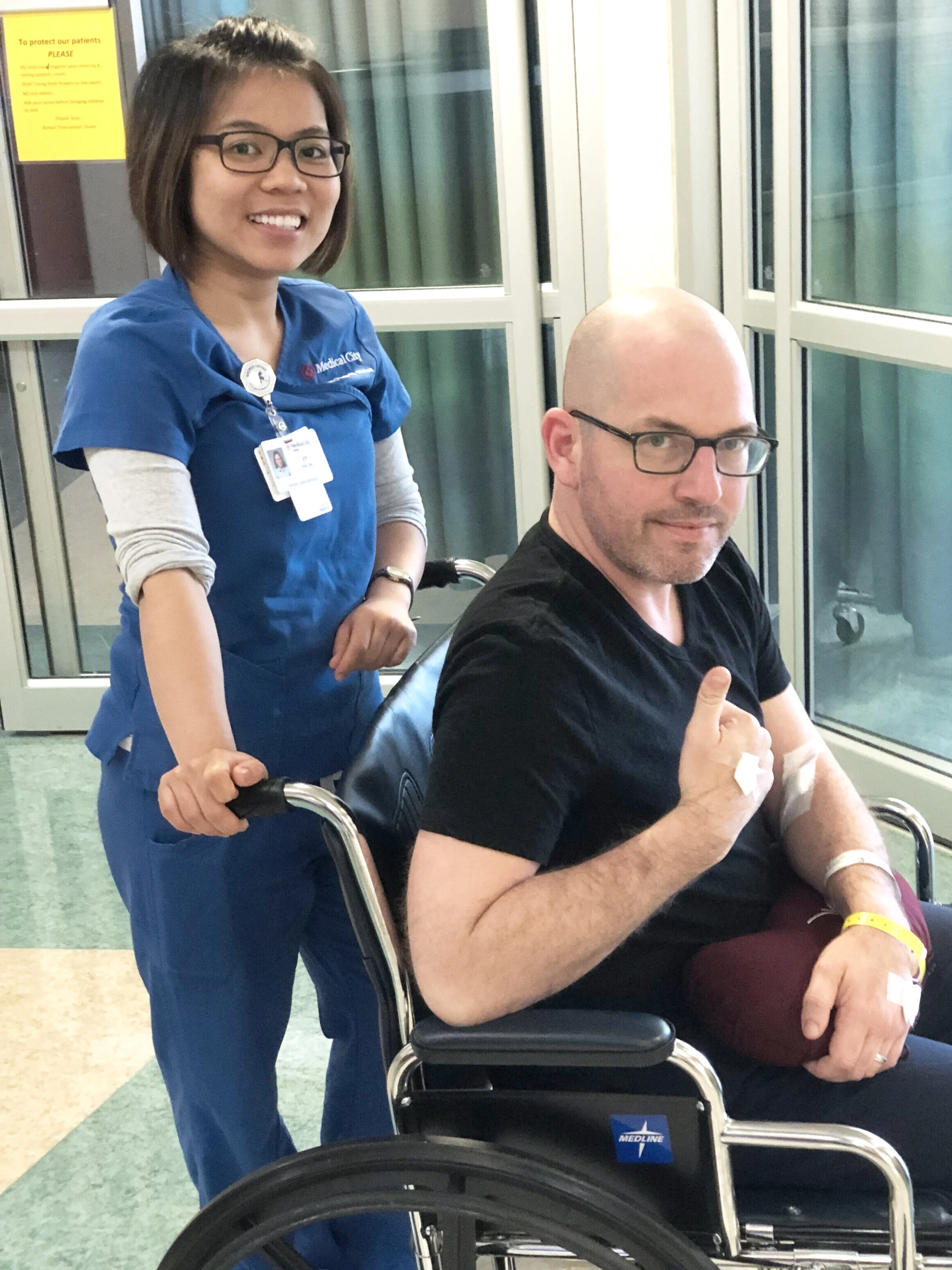
    After only one night in the hospital for observation, I get to go home. After a tricky car ride where my wife did an excellent job avoiding bumps, I’m back at my house. My brother and his wife who’d been watching our two kids greet us at the door. My brother takes a look at my state. A little hunched over, walking slowly wearing slippers and sweatpants. As he helps me into the house he asks casually, “So you dress like this in public now?”

    I felt incredible love and support from friends, family, colleagues, and clients. Some came to visit, some bought me lunch, many people sent Edible Arrangements, and I’m not mad about it.

    I was out of the office for two weeks, but I felt well enough to work after one week. That second week I stopped taking the prescriptions and switched to Tylenol. I felt well enough that I was bored. So I started taking work calls.

    While pain was never really a problem, fatigue was. Those first two or three weeks you’ll be tired. It’s normal. And it goes away completely after about a month.

    Step 12 – Other people carry your luggage

    I wasn’t supposed to lift more than 10 pounds for 6 weeks. But I could go to work. And for me work means travel. For a while there, I couldn’t travel alone. And most of the people on my team are women. So you can imagine the visual. A middle-aged, bald white guy walking through an airport unencumbered by luggage while a younger female colleague carries two bags behind him.

    Step 13 – (Almost) Like it never even happened.

    After my six week check-up, restrictions were lifted and I resumed a completely normal routine. Today the only real differences in my lifestyle are Tylenol instead Advil for a headache, and a few other over-the-counter drug restrictions if I get a cold or something. I’m just as physically healthy as I was before. Probably a little healthier actually, because I’m more intentional about fitness.

    But physical fitness isn’t the whole story. This process has had an enormous impact on my mental, emotional, and Spiritual health too. More on that in a future post.


  • An application, a jug of pee, and three appointments – The living kidney donation process: PART 1

    An application, a jug of pee, and three appointments – The living kidney donation process: PART 1

    By Jon Lee, Founder of Us For Them

    As we begin this mission, I want to be perfectly transparent. I have almost NO idea what I’m doing. That said, I’m hearing a lot of from the early adopters of this idea. Most people have questions about the actual process of donating a kidney. Like, what exactly does it entail? I’ll probably devote a few posts to this topic this year, but let me start with everything I remember taking place before the actual donation.

    The evaluation process was comprehensive, but very simple, and comprised only three appointments. That’s right. The entire pre-donation process for me involved filling out and application and going to exactly three appointments before surgery. Three!

    Step 1: An online application

    Before the first visit I filled out an application online. If you’re interested in being evaluated and you live in North Texas, I highly recommend Medical City Dallas. You can fill out the application here to see if you qualify. I’m a boringly healthy guy. I mean I’m not like super health eater and I’ve never been accused of having ANY athletic ability, but I’m in decent shape and I don’t have any chronic health issues. I am very rarely sick. I didn’t get the flu until I was 35 years old. If you’re a fairly healthy adult you’ll probably pass the application process easily. I think I finished it in less than 10 minutes.

    Step 2: A big jug of pee

    From there they send you a big jug to pee in for 24 hours. Choose a day and start collecting your pee until the next morning. Pro tip: Do it on a weekend. The whole “collecting your urine at work” logistics are… tricky.

    Step 3: Simple labs and vitals

    The next day you’ll turn in your urine jug, get some simple blood work done for labs, and get your vitals checked out (weight, heart rate, blood pressure… simple stuff). The whole appointment took me less than half an hour.

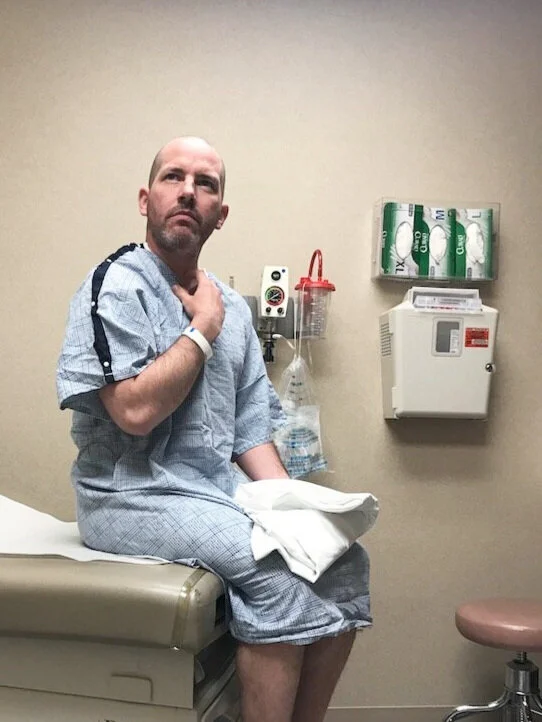
     Me on evaluation day… putting on my brave face… or something.
    Me on evaluation day… putting on my brave face… or something.

    Step 4: Evaluation Day

    If all looks good from the first set up labs, they’ll call you in for a pretty full day of evaluations. You’ll get a physical, more blood work, another urine sample, chest X-ray, EKG, CT scan, a psychological/ social welfare evaluation (to make sure you can afford to take off work, have people who can help with recovery and that you aren’t crazy). It’s all very simple and pretty painless, but they require you to fast for most of the day. Oh, and they make you watch some cartoons.

    Step 5: The waiting game

    From there your case (all of your test results and information) are submitted to a committee made up of transplant surgeons and medical professionals in the organization. They’ll evaluate everything comprehensively, and if all checks out, approve you as a donor. After that you, you wait for a match, unless of course you already have a donor that you match for. In that case you just schedule a date for surgery. Otherwise, if you’re like me (a kidney exchange donor in search of a matched pairing) or if you’re a non-directed donor, they’ll probably give you a very broad estimate to set expectations of finding a match. They told me it could be a couple of months up to a couple of years potentially. I’m not sure if they tell most donors that, but I suspect they do.

    Step 6: The phone call

    The transplant coordinator at your center tells you they found a match and asks about your schedule. You are in control of the schedule. They can work around your life. For me it worked out perfectly. I was able to schedule the donation to take place during a very rare lull in my travel schedule for work.

    Note: This was the moment that the whole thing became real to me. I was sitting in a client meeting in Philadelphia when I received the call. They’d found a match! They were asking about scheduling something in the next three weeks! The phone call caused a certain level of existential whiplash for me. I’d grown comfortable with waiting game after a few weeks – knowing that I was pretty much committed to this journey (although a donor can back out at any time for any reason), but not really thinking about it all that often. Suddenly I was scheduling things. I was informing my co-workers. I was letting my extended family in on the news. It was fast. It was emotionally confusing. But it was the thing I’d been waiting for.

    Be prepared for the phone call to mess with you a bit. It’s natural.

    Step 7: The preproduction meeting

    Sorry. I couldn’t resist one bad advertising joke.

    My last pre-surgery appointment occurred about a week prior to the surgery. It involved another set of simple labs and some logistical instructions for the day of the surgery. More blood and urine samples (get used to peeing in cups a lot) and a few meetings to review your post-surgery plan (who is going to help you get home and get around for the first couple of days, how prescriptions will work, where to go the day of the surgery and what time to get there, etc.).

    That’s it. An application and three appointments. And you’re ready to save and extend somebody’s life.

    If you’re a donor, I’d love to hear from you. Was your experience different than mine? Did I forget any important details that would be helpful for people considering living kidney donation? Let me know.

  • A study on generosity that changed my life

    A study on generosity that changed my life

    By Jon Lee, Founder of Us For Them

    I want to introduce you to a deep dive into the Biblical theme of generosity from our friends at the Bible Project. The video, study notes, and corresponding podcast episodes are an excellent and comprehensive look at how generosity is a critical theme throughout the entire story of the Bible. This study from Tim Mackie and Jon Collins gave me enormous clarity. I celebrate virtually everything these guys produce. It isn’t about kidney donation at all, but the themes and concepts certainly apply to our concept.

    Oftentimes we are taught about generosity through a financial lens, but we are called to acts generosity in every aspect of our lives. And if we believe His promises, we can view our lives from a perspective of absolute abundance – spiritually, physically, and emotionally. That abundance paired with the love of our Creator produces an unquenchable motivation to give and serve others (at least that’s the way it’s supposed to work). If you don’t have hours to devote to the podcast episodes (which I highly recommend), watch this instead.

    Humans are products of God’s generosity designed to receive and to distribute it liberally. The gift of Jesus Christ is our ultimate example. The most generous thing God ever did for us was to sacrifice His only Son for us, that we might be reconciled to Him.

    Sacrificial giving that serves another person is the most fulfilling of all human experiences. As you pray, ask God if he would have you give this life-saving gift – your kidney – to someone who needs a chance at a more abundant life. And if you don’t feel called to give your kidney, ask God what sacrificial gift you can give.

    As always, we thank God for you and we are praying with you.

      Visit their Biblical Generosity theme page
    Visit their Biblical Generosity theme page
  • Hello world!

    Welcome to WordPress. This is your first post. Edit or delete it, then start writing!